
- All
- Product Name
- Product Keyword
- Product Model
- Product Summary
- Product Description
- Multi Field Search
English
Views: 0 Author: Site Editor Publish Time: 2025-10-22 Origin: Site


When evaluating modern machining technology, understanding the difference between 3-axis and 5-axis CNC machines is critical for engineers, toolmakers, and manufacturers aiming to achieve higher quality and faster throughput. In essence, a 3-axis CNC machine operates along three linear movements—X, Y, and Z—while a 5-axis system adds two rotational motions, giving the cutting tool the freedom to approach the workpiece from virtually any direction. This fundamental difference influences everything from achievable accuracy and surface finish to setup efficiency and overall cost.
For simple, flat components, 3-axis machining remains a cost-effective solution. However, for intricate shapes, multi-sided features, and high-precision parts, the advantages of 5-axis machining—reduced setups, superior finishes, and consistent tolerances—can make a measurable difference. As manufacturing continues to evolve toward precision and automation, understanding this difference helps decision-makers choose the right technology for their production goals and budgets.
A 3-axis CNC machine is the foundation of subtractive manufacturing. It allows the cutting tool to move side-to-side (X), front-to-back (Y), and up-and-down (Z). These three axes define most standard milling and drilling operations. 3-axis systems are ideal for machining flat surfaces, slots, holes, and simple contours. They are widely used across job shops, metalworking plants, and fabrication centers due to their affordability, simplicity, and proven reliability.
However, a major limitation arises when parts require features on multiple faces. To access different sides, operators must stop the machine, manually reposition the part, and recalibrate the tool. Each new setup introduces minor alignment errors, consumes time, and adds complexity. Over multiple steps, this can affect precision and extend production cycles. For high-volume or high-tolerance industries, those inefficiencies become costly.
The addition of the A-axis (rotating around X) and the B-axis (rotating around Y) transforms machining from linear cutting to full spatial motion. With these two extra degrees of freedom, a 5-axis CNC machine can orient the tool or the part dynamically, keeping the cutting edge in constant optimal contact with the material.
This means a 5-axis setup can:
Machine five faces of a part in one operation.
Eliminate manual repositioning and multiple fixtures.
Maintain tool angle for consistent surface pressure and finish.
Achieve smooth transitions on complex contours and freeform surfaces.
In practical terms, this is the difference between milling a flat bracket and sculpting a turbine blade. A 3-axis machine cuts efficiently but must stop and reorient frequently. A 5-axis machine keeps moving seamlessly, producing aerodynamic curves, smooth surfaces, and micro-precision details that meet aerospace or medical-grade requirements.
This freedom also translates into reduced tool wear, lower scrap rates, and faster cycle times—essential advantages in high-value production environments.
Precision, surface quality, and throughput determine how effectively a machining process meets customer expectations.
A 3-axis machine can reach impressive accuracy levels—often around ±0.01 mm—but it faces limits when machining contoured or inclined surfaces. Tool vibration and repeated setups increase the chance of minor deviations. The finish often requires secondary polishing, which adds cost and time.
By contrast, a 5-axis machine maintains continuous tool contact at optimal angles, minimizing tool pressure and vibration. This ensures uniform surface texture, outstanding precision, and mirror-like finishes directly from the mill. Complex geometries that previously required multiple setups can now be completed in one go.
Let’s summarize these differences clearly:
Factor | 3-Axis CNC | 5-Axis CNC |
Axes of Motion | X, Y, Z | X, Y, Z + A, B (rotation) |
Precision Range | ±0.01 mm typical | ±0.002–0.005 mm achievable |
Surface Finish | Good, may need polishing | Excellent, near optical finish |
Setup Time | Multiple setups needed | Single setup for complex parts |
Cycle Time | Moderate to long | Shorter overall, fewer stops |
Tool Life | Average | Extended due to optimal angle |
Ideal Parts | Flat, prismatic components | Curved, multi-faced, high-tolerance parts |
For instance, in aerospace manufacturing, an impeller or turbine blade must meet tight aerodynamic tolerances and flawless surface continuity. Such parts are almost impossible to finish economically on 3-axis equipment but are routine for a 5-axis CNC machine.
The takeaway: 3-axis excels in simplicity and affordability; 5-axis dominates in precision, quality, and speed for complex designs.
While 5-axis technology is undeniably powerful, it requires greater investment and skill to fully utilize.
A 3-axis CNC machine generally costs less to purchase, maintain, and operate. Programming is straightforward—tool paths are linear, and collision risks are minimal. Operators with basic G-code knowledge can manage these machines effectively.
However, 5-axis machining introduces simultaneous multi-axis movement. Programming must account for continuous changes in tool orientation and spatial positioning, requiring advanced CAM (Computer-Aided Manufacturing) software and higher operator expertise.
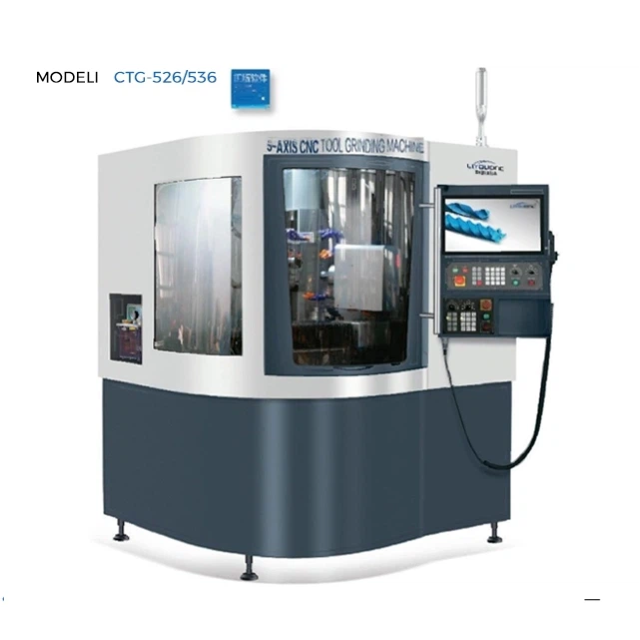
That said, automation and intelligent controls are transforming this landscape. Liyou’s 5-axis CNC tool grinding machine integrates precision servo drives with automatic tool setting and error compensation technology. This innovation significantly lowers the learning curve for operators by calibrating and adjusting automatically. With repeatability up to ±0.002 mm, the system ensures consistent performance and minimal human error.
The distinction between 3+2-axis and true 5-axis machining also deserves mention. 3+2-axis systems allow the tool or workpiece to be positioned at fixed angles, performing machining with static orientation. True 5-axis systems perform all five motions simultaneously, making them essential for sculpted geometries, high-speed contouring, and freeform surfaces.
From an ROI standpoint, the higher upfront cost of 5-axis systems is offset by improved productivity, reduced scrap, and faster job turnaround—especially when automation features, like those in Liyou’s design, streamline setup and operation.
The transition to 5-axis machining has accelerated across several precision-focused industries:
Aerospace – For blades, impellers, and structural parts requiring contoured surfaces and tight tolerances.
Medical Devices – For orthopedic implants, surgical tools, and dental components demanding smooth, biocompatible surfaces.
Mold & Die – For complex injection molds and press dies requiring intricate cavities and undercuts.
Automotive – For performance components like valve housings, combustion chambers, and prototypes requiring accurate geometry.
Energy & Turbomachinery – For impellers, rotors, and compressor wheels where multi-axis precision ensures efficiency and balance.
These industries rely on 5-axis systems not only for shape complexity but also for process consistency. The ability to complete multi-surface machining in one cycle improves part integrity and repeatability, while also cutting lead times—an essential advantage in competitive global supply chains.
Liyou’s 5-axis CNC tool grinding machine serves these applications with unmatched stability and adaptability. Its intelligent grinding process database enables rapid switching between tool types, supporting both small-batch customization and large-scale production. The result is a machine that enhances flexibility without sacrificing precision.
What makes Liyou’s system stand out in the 5-axis landscape is not only its precision but its approach to automation and operator convenience.
The machine adopts a high-rigidity structural design that minimizes vibration and ensures dimensional stability even under heavy workloads. Its precision servo drive system guarantees smooth, responsive motion control. Combined with intelligent automatic tool setting and error compensation, this technology ensures consistent accuracy across every cycle.
Key advantages include:
Repeatability up to ±0.002 mm, ensuring reliable performance for demanding industries.
Intelligent automation, reducing the need for manual calibration and operator intervention.
Automatic tool changing system, supporting 24-hour continuous operation and minimal downtime.
Flexible grinding wheel configurations, allowing quick adaptation between different tool geometries.
For workshops transitioning from 3-axis to 5-axis technology, such features dramatically simplify the upgrade process. Operators spend less time on setup, while automated diagnostics and compensation systems maintain stability and accuracy over time.
In practice, this means faster production, reduced labor dependency, and consistent output—factors that directly contribute to higher profitability and better product quality. For sectors like aerospace, automotive, and medical manufacturing, where every micron matters, Liyou’s high-precision grinding technology provides an unbeatable combination of speed and reliability.
Before deciding which platform fits your needs, consider the following:
Part Complexity – Are your components simple or highly contoured?
Production Volume – Do you need quick turnarounds or large-batch efficiency?
Required Tolerance and Finish – How tight are your tolerances? Is post-processing acceptable?
Budget and ROI – What investment level fits your production goals?
Automation Needs – Do you require continuous, unattended operation?
If your parts demand multi-surface machining, tight tolerances, or continuous production, upgrading to a 5-axis system will deliver long-term advantages. For many precision workshops, adopting a machine like Liyou’s advanced grinder bridges the gap between complexity and efficiency—offering world-class precision without excessive operator dependency.
In today’s precision-driven industries, the debate between 3-axis and 5-axis machining is no longer just about capability—it’s about competitiveness. A 3-axis system remains practical for simple components, but a 5-axis CNC machine represents the new standard for innovation, accuracy, and automation.
Liyou’s advanced tool grinding solution redefines what manufacturers can expect from multi-axis machining. By combining high rigidity, precision servo drives, intelligent control, and 24-hour automated operation, it offers an ideal blend of flexibility and performance. Whether you’re building aerospace components, medical implants, or complex cutting tools, this technology ensures stability, reliability, and repeatability that meets the highest global standards.
To explore how Liyou’s precision solutions can optimize your workflow or to request a customized demonstration, please contact us today and discover how multi-axis technology can transform your production capabilities.


