
- All
- Product Name
- Product Keyword
- Product Model
- Product Summary
- Product Description
- Multi Field Search
English
Views: 0 Author: Site Editor Publish Time: 2025-10-29 Origin: Site


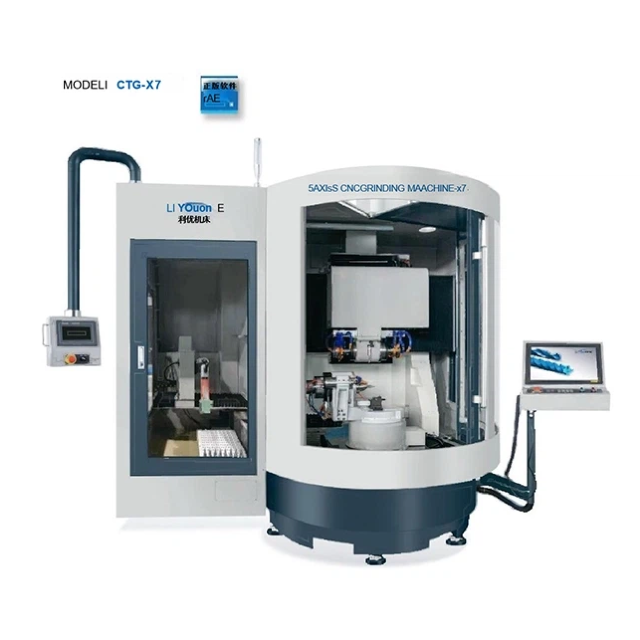
Liyou builds advanced machining and grinding solutions for precision manufacturing. A 5-axis cnc machine brings movement on five independent axes to the milling process so shops can cut complex three dimensional shapes in a single setup while preserving accuracy and surface finish. This article explains what makes a mill truly five axis, compares common machine configurations, lists the important specifications buyers should compare, and shows when a full 5-axis mill is the right tool for the job.
A mill is called five axis when its cutting tool or workpiece can move along five independent axes during machining. Conventional mills move linearly along three axes named X, Y and Z. A five axis system adds two rotational axes that are typically called A and B or B and C depending on the manufacturer. Those extra degrees of freedom let the tool approach the part from virtually any direction. The practical results are fewer setups, better tool engagement angles, improved surface finish, reduced need for manual fixturing, and the ability to machine features that would otherwise be impossible without extensive secondary operations.
There are three common layout families for five axis milling. Each has tradeoffs for tooling, accessibility, programming complexity and fixture design.
A trunnion table holds the workpiece on a swiveling table that rotates around two axes. The spindle remains fixed in orientation while the table rotates the part into position. Pros include excellent rigidity for heavy parts and straightforward workholding. Cons are that larger work envelopes require physically large tables making fixturing for long parts more complex.
A swivel head machine retains a fixed table but the spindle head itself tilts and rotates. This configuration is compact and excels for part access because the tool can sweep around fixed fixtures. The drawback is that spindle-mounted heads can be less rigid when heavily loaded which limits aggressive cutting on hard alloys.
A tilting rotary table is a hybrid where a single rotary axis is integrated with a programmable tilt. It is often used in shops that mix 3 axis work with occasional five axis jobs because it retrofits or fits into smaller footprints. Its main advantage is cost effectiveness for shops that do not need full continuous five axis simultaneous motion. The downside is reduced simultaneous axis range compared with dual-axis trunnion tables.
Feature | Trunnion table | Swivel head | Tilting rotary table |
Rigidity | High | Medium | Medium to High |
Best for | Large complex parts | Compact parts, accessibility | Small to medium parts, retrofit use |
Fixturing complexity | Higher for long parts | Lower | Moderate |
Indexing vs simultaneous 5-axis | Excellent for true simultaneous | Good for simultaneous | Often used for 3+2 indexing |
Typical applications | Aerospace structural parts | Mold and die detail, medical | Toolrooms, job shops |
When evaluating machines, buyers should look beyond the number of axes and compare attributes that determine productivity and part quality.
Spindle speed and power
High spindle speed is valuable for small diameter tools and finishing passes. Spindle power and torque are crucial when roughing or cutting tough alloys. For each job profile check the torque at the spindle speed you intend to use.
Table size and axis travel
Table area and linear travels define the maximum workpiece envelope. Consider not only the travel in each axis but also how the rotational axes interact with linear travel. Two machines with similar X Y Z travel can produce very different reachable geometries depending on axis layout.
Tool changer capacity and tool management
Larger tool magazines reduce non cutting time for complex jobs. Also examine how the control organizes tool offsets, wear history, and tool life management.
Machine rigidity and thermal control
Structural stiffness directly affects surface finish and allowable feed rates. Thermal compensation, a robust base, and well supported column designs lead to better long run accuracy.
Repeatability and accuracy
Ask vendors for both positioning accuracy and repeatability. For tight tolerance aerospace and medical parts repeatability is often the limiting factor that determines whether rework is required.
Control system and software ecosystem
A modern five axis controller with built in collision avoidance and a process database accelerates programmer productivity. Compatibility with major CAM packages and availability of post processors matters.
Fixturing options and probing systems
Integrated probing and flexible modular fixturing reduce setup time and support automation. Verify if the machine supports automated pallet change when running lights out.
A 3-axis mill with multiple setups or a 3+2 indexed approach can handle many parts that do not require continuous five axis motion. Use these guidelines to decide.
Choose a full 5-axis mill when
• The part geometry requires continuous multi axis tool orientation for smooth surfaces such as sculpted aerospace surfaces or freeform medical implants.
• You want to reduce setups to a single clamping to improve accuracy and lower fixturing labor.
• Complex cavities, undercuts, deep features with steep sidewalls, or angled holes are common in your production mix.
• Throughput and cycle time reductions from simultaneous five axis machining will pay back the higher machine cost.
Choose 3-axis with fixtures or 3+2 when
• The bulk of your work involves prismatic features or features aligned to primary faces that can be accessed with indexing.
• Your volume and unit value do not justify the capital cost of a full five axis cell.
• You prefer a simpler programming workflow and your shop has fixturing expertise to minimize setup errors.
The economic tipping point is project specific. For highly engineered, low volume aerospace and medical components the value of one-clamp machining combined with reduced inspection and rework frequently justifies five axis machines. For high volume simple prismatic production the added cost may not provide proportional benefit.
A modern small lot high variety shop benefits when tool manufacture and machining processes are harmonized. Liyou machines are designed with that workflow in mind. When a shop uses a 5-axis milling machine alongside a high precision tool grinding machine, the advantages are tangible.
Faster tool turnaround
When tools are ground on a dedicated five axis tool grinding machine they can be reproduced to tight geometric tolerances which results in more consistent cutting performance on the mill.
Matched tolerances and tool profiles
Grinders that support multi axis dressing and intelligent process databases produce cutters whose geometry matches the mill programmer’s expectations. This reduces in process adjustments and scrap.
Reduced downstream rework
Consistent tools deliver predictable tool life and wear patterns. Fewer unexpected tool failures lower the need for rework and improve first pass yield.
Process database synergy
When both grinding machines and mills use an intelligent process database, setups can be standardized. Tool assemblies can be recalled for repeat jobs, shortening setup and ramp up.
Purchasing a five axis mill requires investing in people and processes. Consider these maintenance and training elements.
Serviceability and preventive maintenance
Assess how easily service panels can be removed, the accessibility of bearings and drives, and availability of spare parts. A robust preventive maintenance plan keeps throughput steady.
Calibration and verification
Periodic geometric verification and thermal drift checks preserve accuracy. Many shops adopt a routine that includes probing reported offsets and axis compensation.
Tool-setting systems and offsets management
Automatic tool setters that integrate with the control reduce manual offset errors. A systematic approach to tool life logging helps schedule replacements before catastrophic breakage.
Operator skill and CAM programming
Five axis programming is more complex. Invest in CAM training and simulation tools to teach simultaneous motion strategies. Hands on training for machine operators ensures safe axis limits are managed and setups are repeatable.
Recommended training scope includes controller operation, basic axis kinematics, probing and fixture setup, and one to two real world programming projects to build confidence.
A 5-axis mill is ideal for sculpted aerodynamic surfaces such as turbine blades, complex impellers, freeform medical implants, precision molds and dies with undercuts, and structural aerospace parts featuring intricate stiffness ribs and surfaces. High aspect ratio deep pockets with angled sidewalls are easier to finish with multi axis tilt to maintain constant tool engagement. Another advantaged area is trimming composite parts where the tool angle needs to follow the composite curvature for consistent laminate cuts.
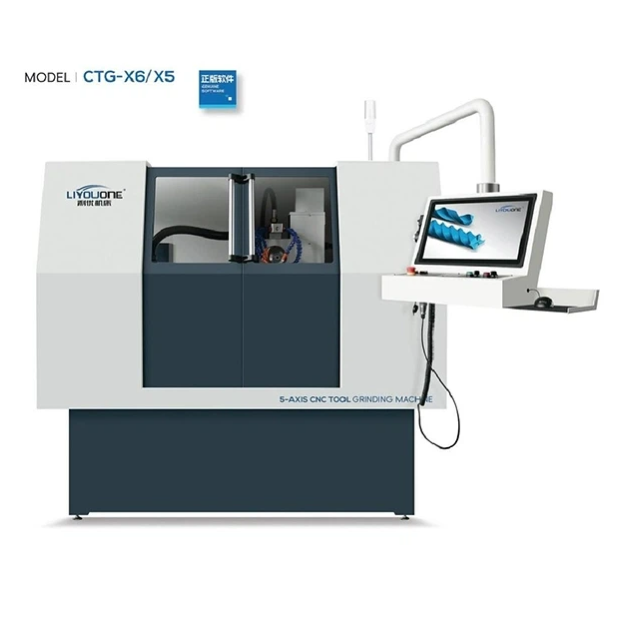
Liyou designs machines and process solutions that help shops get more from multi axis machining. If your production requires the versatility and single-setup accuracy of advanced multi axis milling paired with reliable tool grinding workflows consider exploring our integrated solutions such as the 5-Axis CNC Tool Grinding Machine. For a detailed quotation or to schedule a demo please contact us.
Contact us
Email sales at Liyou or use our website inquiry form to request machine specifications, a sample demo, or financing options. Our application engineers will help match the right 5-axis mill and associated tool grinding equipment to your part mix and production goals.


